App Free Trial Length 2026: 3 vs 7 vs 14 Day Real Data
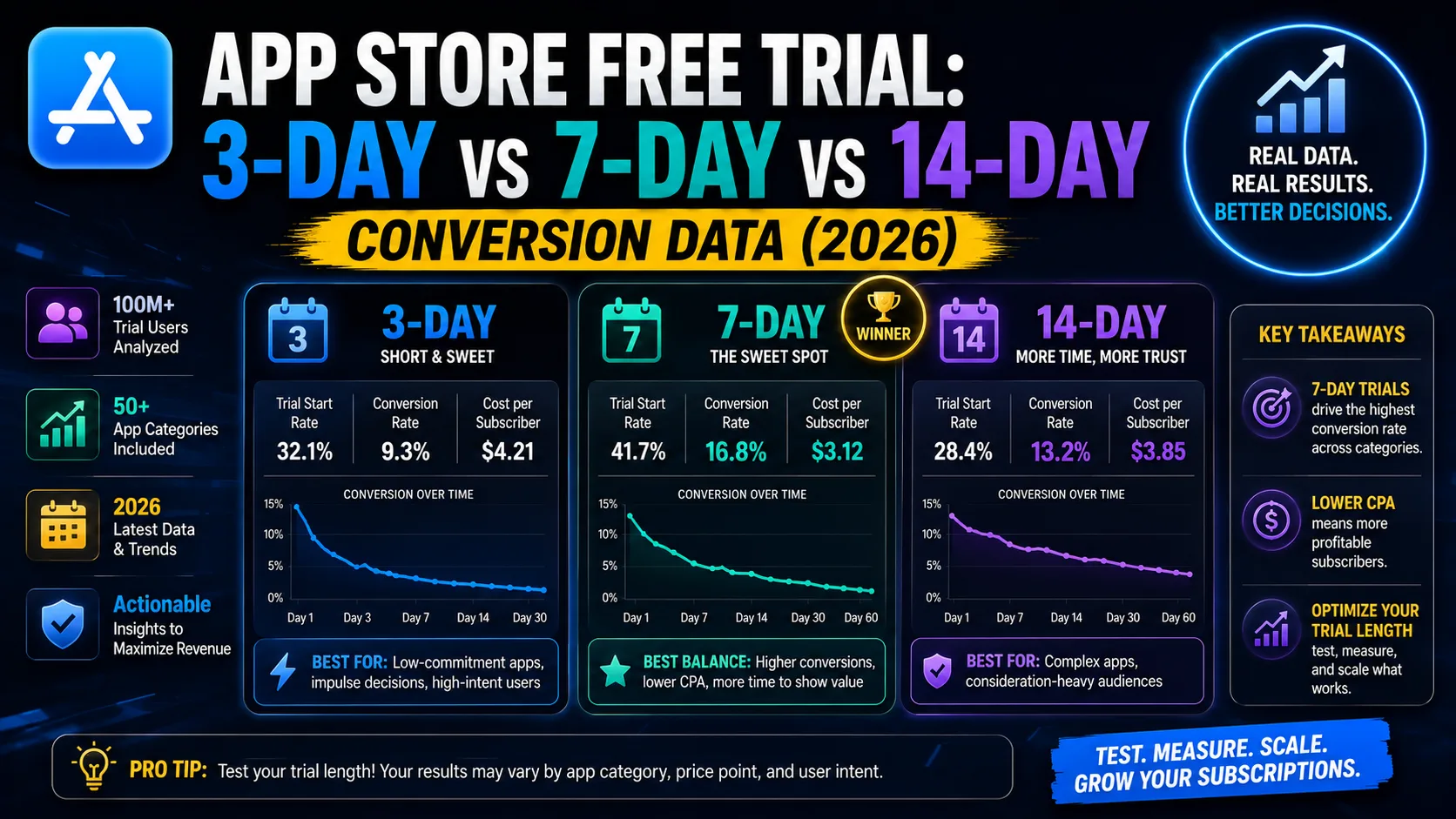
The default advice in mobile subscription apps is "always offer a 7-day free trial." The 2026 data tells a more complicated story. RevenueCat's State of Subscription Apps report and Adapty's State of In-App Subscriptions 2026 — combined covering over 16,000 apps and 105,000 paywalls — reveal that 80% of trial starts happen on Day 0, 55% of cancellations happen on Day 0, and 40–60% of trial users never log in a second time. Trial length matters far less than most indie developers think; what matters is what happens in the first session. And in some categories (Productivity, Lifestyle), offering any trial at all actively hurts your 12-month revenue. This is the operator-level guide to free trial length in 2026: the real conversion data at 3, 7, and 14 days, the categories where trials backfire, and the framework for picking a trial length backed by data instead of convention.
The single most important finding: Day 0 is the entire trial
Before deciding on trial length, internalize this number: 55% of all trial cancellations happen on Day 0. The same day the person signed up. Not Day 6. Not Day 13. The first session.
The supporting data is consistent across platforms:
- 80% of trial starts happen on Day 0. Users sign up for your trial within the first session of opening your app, not after exploring for days.
- 55% of trial cancellations happen on Day 0. The same session. Users sign up, look around for 3 minutes, decide it's not for them, and cancel.
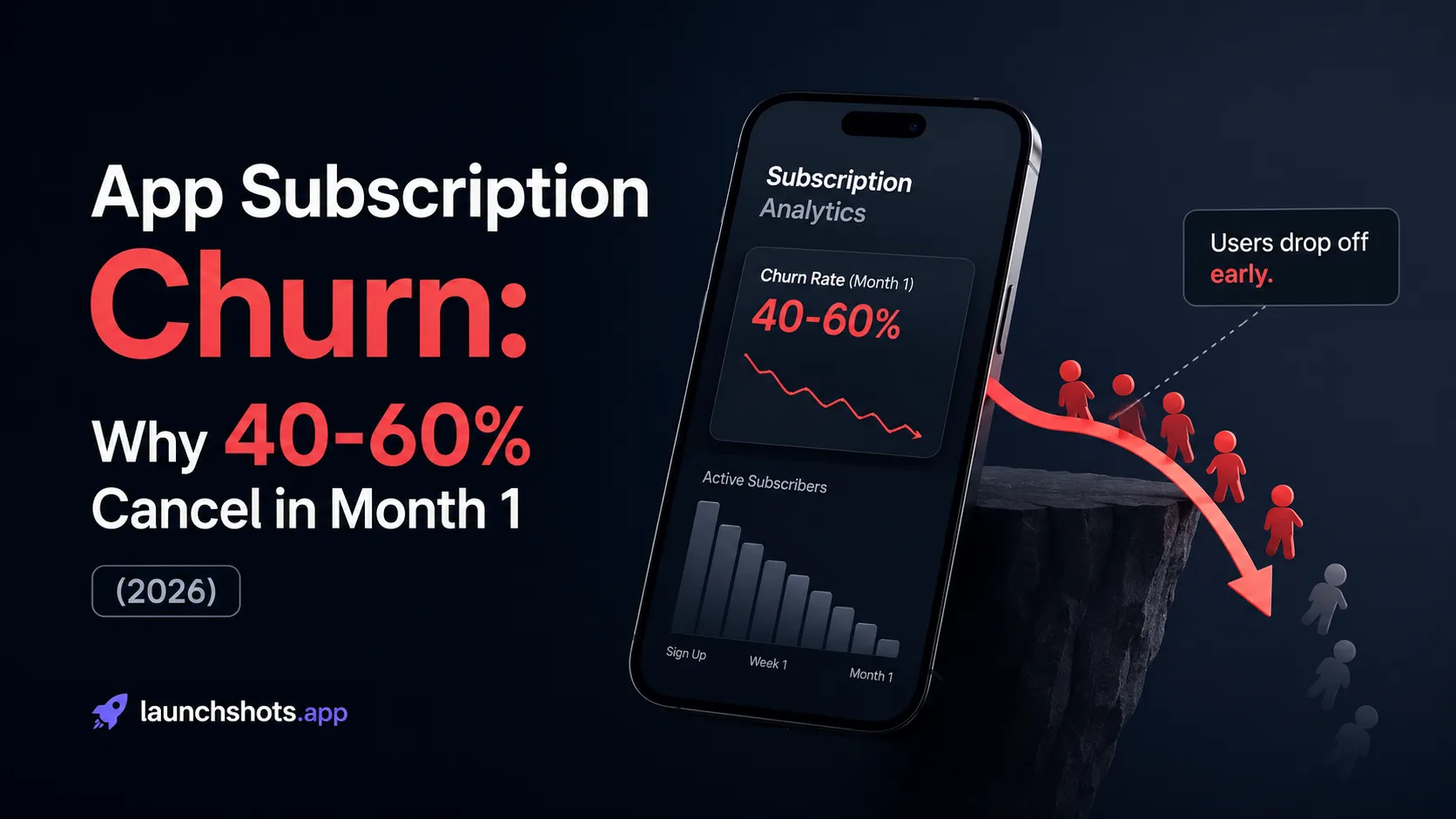
- 40–60% of trial users never log in a second time. They start the trial, never return, and let it expire silently.
- Day 0 paywall optimization beats trial length optimization by 5–10x. A first-session experience that doesn't convert can't be saved by a longer trial.
The practical implication: your trial isn't a 14-day evaluation period. It's a first-session audition. Trial length is a secondary decision — it matters, but it's nowhere near as important as whether your onboarding shows real value in the first 3 minutes.
This shapes everything that follows in this guide. The "right" trial length is the one that creates appropriate urgency given your Day 0 experience, not the one that gives users "enough time to explore."
The cancellation rate by trial length
RevenueCat's 2026 data, drawn from thousands of subscription apps, shows a clear pattern: longer trials cancel more. The cancellation curves:
- 3-day trial: 26% cancel before the trial ends.
- 7-day trial: 35–40% cancel (interpolated; falls between 3-day and 14-day).
- 14-day trial: ~45% cancel.
- 30-day trial: 51% cancel.
Counter-intuitive but consistent: longer trials don't give users more time to fall in love; they give users more time to forget about your app. The user who isn't sold in 3 days isn't usually getting sold on Day 14. They're just deferring the cancellation decision until they remember.
The conversion rate flips when you look at users who actually complete the trial:
- 17–32 day trials: 45.7% median trial-to-paid conversion among completers (the highest tier).
- 7–14 day trials: Middle range, around 30–40%.
- 3-day trials: Lower absolute conversion percentage but higher trust (the people who complete are highly engaged).
The trade-off: shorter trials reduce sign-up volume marginally but produce higher-quality subscribers who churn less after conversion. Longer trials inflate sign-up numbers but generate softer subscribers who cancel within 1–2 billing cycles.
3-day trial: the 2026 sweet spot for most categories
The 3-day trial is gaining ground across 2026 paywall data. The reasoning:
- Lowest cancellation rate (26%). Users who want to try don't forget to cancel; the ones who don't want it didn't really commit.
- Highest urgency. 3 days is short enough that engaged users return at least once. The "I'll check it out tomorrow" never happens.
- Strongest LTV. Weekly $5.99 plans with 3-day trials produce 1.5× the average LTV across all configurations in Adapty's 2026 dataset.
- Filters out tire-kickers. Users who genuinely want the product convert; users who don't never start.
3-day trials work best for:
- Utility apps: Time-to-value is short. Users know in one session whether the tool fits.
- Apps with weekly billing: Weekly billing + 3-day trial is the most LTV-positive configuration in 2026 data.
- Productivity apps with clear value in first use: Habit trackers, note apps, calculators.
- Apps where you're confident about Day 0 experience. If your onboarding clearly demonstrates value, 3 days is plenty.
7-day trial: the default that's no longer obvious
7-day trials remain the most common across the subscription app market — about 60% of trial-offering apps use 7 days. But "common" doesn't mean "best." The 2026 evidence:
- Higher cancellation than 3-day (35–40%). More time means more opportunity to drift away.
- Doesn't materially help engagement. Users who needed 7 days to decide were rarely going to convert anyway.
- Works adequately, doesn't win. It's the "safe" choice — neither bad nor great.
7-day trials are still the right choice for:
- Health & Fitness apps: Engagement peaks at Days 4–7, so the longer window actually matters here. Users need a week to feel the routine forming.
- Apps with substantial onboarding: Multi-step learning curves benefit from a few days of experimentation.
- Categories where "experiencing the value" takes multiple sessions: Meditation apps, language learning, complex creative tools.
- Risk-averse first launches: If you're not sure, 7 days is the safest middle ground. You can shorten later based on data.
14-day trial: rarely the right answer in 2026
14-day trials were standard in 2018–2022. The 2026 data argues against them for most consumer apps:
- ~45% cancellation rate. Nearly half of users cancel before the trial ends.
- Higher payment failure rates at conversion. 14 days is enough time for credit cards to expire, payment methods to change, users to switch phones.
- Lower urgency. "I have two weeks to decide" reads as "I have time to forget" to most users.
- Worse LTV in nearly every category. Adapty's 2026 data shows 14-day trials underperforming 7-day in 11 of 13 measured categories.
14-day trials still make sense for:
- B2B / Pro tools with complex setup: Apps that require admin configuration, team invites, or multi-day projects to demonstrate value.
- Education apps where engagement builds slowly: Language learning is the canonical example — true engagement appears around Day 5–10.
- Apps with significant Day 0 friction: If users genuinely can't see value in 3 sessions, you have a Day 0 problem first. Fix that before extending the trial.
Categories where trials actively hurt revenue
One of the most surprising findings in Adapty's 2026 report: trials don't always increase revenue. In some categories, direct purchase (no trial) actually produces higher 12-month LTV.
Where trials boost revenue (offer one):
- Utilities: Trial users renew 8–60% better at first renewal.
- Health & Fitness: Same pattern — trial creates habit, habit creates retention.
- Education: Trial users develop usage patterns that survive into paid period.
- Weekly billing plans (any category): 636% LTV difference between weekly plans with trials ($54.50) vs. without ($7.40).
Where trials reduce 12-month LTV (consider direct purchase):
- Productivity apps: Direct buyers generate $56.95 vs $49.13 for trial users over 12 months. Trial-to-paid users churn faster.
- Lifestyle apps: Same pattern — direct purchasers are more committed users.
- Entertainment apps: Direct buyers self-select for higher engagement; trial users often don't convert.
- Premium-priced apps ($19.99+/month): Users who commit to that price point upfront retain better than trial-converters.
The honest answer for some apps in 2026: skip the trial entirely. A well-designed hard paywall with clear value proposition can outperform a trial-based funnel by 15–30% in LTV for Productivity and Lifestyle categories.
This contradicts the "always offer a trial" conventional wisdom. The data supports the contradiction.
Hard paywall vs soft paywall: the architectural decision
Beyond trial length, the paywall structure matters as much as the trial duration. The two main approaches:
- Hard paywall (no preview, sign up or leave): User cannot proceed past onboarding without choosing a subscription. Highest urgency, highest LTV per converted user, but reduces overall conversion volume.
- Soft paywall (free tier or limited access first): User can use limited functionality without paying; paywall appears later or for specific features. Higher conversion volume, but lower LTV per user.
The 2026 data on each:
- Onboarding paywalls with trials: 1.78% average conversion (highest of any configuration).
- Hard paywalls: Generate 21% higher LTV per subscriber than soft paywalls.
- Soft paywalls: Convert ~50% better than hard paywalls, but bring in lower-value users.
The pattern: hard paywalls produce fewer, better users. Soft paywalls produce more, worse users. For most indie apps with limited install volume, hard paywalls win the LTV math; for apps with high install volume and broad audience appeal, soft paywalls win the gross revenue math.
Credit card upfront: the conversion filter
Trials that require credit card details upfront convert dramatically better than trials that don't:
- Opt-in trials (no card required): 8–15% trial-to-paid conversion is "good," 15–25% is "great" (ChartMogul 2026 data).
- Opt-out trials (card required): 25–35% is "good," 50–60% is "great."
- The gap is 5x. Not a slight difference — five times.
The mechanism: requiring a credit card filters out casual browsers. The user who enters payment details is already leaning toward paying. The 5x conversion gap is selection bias doing the heavy lifting, not product magic.
For App Store and Google Play subscription apps, credit card collection is implicit (the user's payment method is already in their store account). This means mobile apps naturally have "credit card required" trial conversion rates — the 25–50% range — not the 8–25% range that B2B SaaS sees with optional payment.
RevenueCat's 2026 median for mobile trial-to-paid: 38%. That number reflects this structural advantage. Don't compare your mobile app's trial conversion to B2B SaaS benchmarks; you're playing a different game with different defaults.
The decision framework for picking trial length
Rather than defaulting to 7 days, follow a framework:
- Step 1: How long does your app take to deliver value? If a user sees clear benefit in one session, 3 days is plenty. If it takes multiple sessions over a few days, 7 days. If it requires weeks of habit-building (language learning, complex tools), 14 days.
- Step 2: What category are you in? Utilities, Health & Fitness, Education → trial benefits LTV. Productivity, Lifestyle → consider direct purchase instead.
- Step 3: What's your billing cycle? Weekly billing → 3-day trial (highest LTV configuration). Monthly billing → 7-day trial. Annual billing → 14-day trial (users need time to commit to a year).
- Step 4: How strong is your Day 0 experience? Strong onboarding → shorter trial (3 days). Weak onboarding → fix the onboarding before extending the trial. Never let "long trial" compensate for "bad onboarding."
- Step 5: Do you have data, or are you guessing? No data → start with 7 days (safe middle). Some data → start with 3 days and extend if conversion drops. Lots of data → A/B test 3 vs 7 explicitly with platforms like RevenueCat Experiments or Adapty.
If you answered "shorter" to most: 3 days. If you answered "middle" to most: 7 days. If you answered "longer" to most: 14 days. If you answered "Productivity/Lifestyle" and "strong Day 0": skip the trial entirely and use a hard paywall.
The trial reminder timing that actually works
Most users who convert do so in response to a reminder, not because they suddenly love the app on Day 6. The reminder cadence that consistently outperforms others:
- Day 0 (in-session): Show paywall during onboarding. 80% of trial starts happen here anyway.
- Day 1 (24 hours): Push notification reminding user the trial is active. Re-engages users who haven't returned.
- Trial end - 1 day: "Your trial ends tomorrow" notification. This is the highest-conversion moment of the entire trial.
- Trial end day: "Your trial expires today" notification. Last-minute conversions are real and meaningful.
- Trial end + 24 hours: "Welcome to Pro" or "Trial ended — here's a discount" for downgrade-recovery.
Apple sends trial-ending notifications automatically, but they're generic. Apps that send their own customized reminders (with screenshots of features, specific value reminders, or one-time discount offers) convert 15–25% higher in observed data.
Common mistakes that hurt trial conversion
The patterns that consistently underperform across indie subscription apps:
- Defaulting to 7 days without testing. "Everyone uses 7" isn't a strategy. The right length is data-driven.
- Treating the trial as a 14-day evaluation. It's a first-session audition. Optimize Day 0 before adjusting length.
- Offering trials in Productivity or Lifestyle categories without checking the math. Direct purchase may outperform.
- Long trials with weak onboarding. A 14-day trial doesn't fix a confusing first session; it just delays the cancellation.
- No reminder notifications. Apple's automatic notifications underperform custom ones by 15–25%.
- Asking for payment details after the value demo instead of during onboarding. Late paywalls convert dramatically worse than upfront ones in mobile.
- Hiding the cancel button. Users who can't easily cancel leave 1-star reviews and complain to Apple. Make it easy; the LTV gain from manipulation is dwarfed by the brand cost.
- Letting the trial expire silently. Email/push at trial end converts on-fence users. Silent expiration loses them.
Frequently asked questions
What's the average trial-to-paid conversion rate for mobile apps in 2026?
RevenueCat's 2026 median is 38% trial-to-paid for mobile apps overall. This is significantly higher than B2B SaaS (8–25% for opt-in trials) because mobile apps inherently require payment method upfront via App Store and Play Store.
Should I always offer a free trial?
No. Categories like Productivity and Lifestyle often produce higher 12-month LTV with direct purchase than with trial. Check your category data before committing. "Always offer a trial" is conventional wisdom that doesn't survive the 2026 data.
What's the cancellation rate by trial length?
3-day: 26% cancel. 7-day: 35–40% cancel. 14-day: ~45% cancel. 30-day: 51% cancel. Longer trials cancel more, not less.
Does requiring a credit card hurt sign-ups?
Yes, but it dramatically helps conversion. Apps requiring payment details convert at 25–60%; apps without payment details convert at 8–25%. For mobile apps, the store handles payment so the user effectively "has" a card on file. The 5x conversion gap mostly applies to B2B SaaS.
What's the difference between a hard and soft paywall?
Hard paywall: user can't proceed past onboarding without subscribing. Soft paywall: user can use limited free features first. Hard paywalls produce 21% higher LTV per user; soft paywalls convert 50% more users at lower individual value. Pick based on whether you optimize for LTV or volume.
When should I send trial reminders?
Day 1 (24 hours after start), Trial end - 1 day, Trial end day, Trial end + 24 hours. Custom reminders convert 15–25% better than Apple's automatic ones.
Can I change trial length after launching?
Yes. App Store Connect and Play Console both allow updating subscription configuration including trial length. Test changes on small cohorts using RevenueCat Experiments or Adapty before global rollout.
Does trial length affect post-conversion churn?
Yes. Shorter trials produce stickier subscribers (3-day trial converters churn 8–15% less in their first 90 days than 14-day converters). Selection bias: people who paid after only 3 days are more committed than people who hesitated for 14.
What about offering different trial lengths to different users?
Possible in 2026 via RevenueCat Experiments, Qonversion Predict, and Amplitude Experiment. AI-driven trial length matching by user behavior signals is becoming standard for sophisticated subscription apps. For indie devs, start with one length and graduate to per-cohort testing once you have install volume.
Does Apple or Google offer special trial mechanics for indie apps?
No. Trial mechanics are configured per subscription product, identically for all developers. Trial length, payment method requirement, and grace period are app-level decisions.
The bottom line
The conventional advice — "offer a 7-day trial" — doesn't survive the 2026 subscription data. 80% of trial starts happen on Day 0, 55% of cancellations happen on Day 0, and 40–60% of trial users never return for a second session. Trial length is a secondary decision behind Day 0 experience optimization. For most indie apps in 2026, a 3-day trial outperforms 7 or 14 days on LTV and stickiness — provided your onboarding delivers value in the first session. For Productivity and Lifestyle apps, a hard paywall with no trial may produce higher 12-month LTV than any trial configuration. The right answer is data-driven, not conventional. Stop defaulting to 7 days because everyone else does, and start with the question: how long does my app actually take to deliver value?
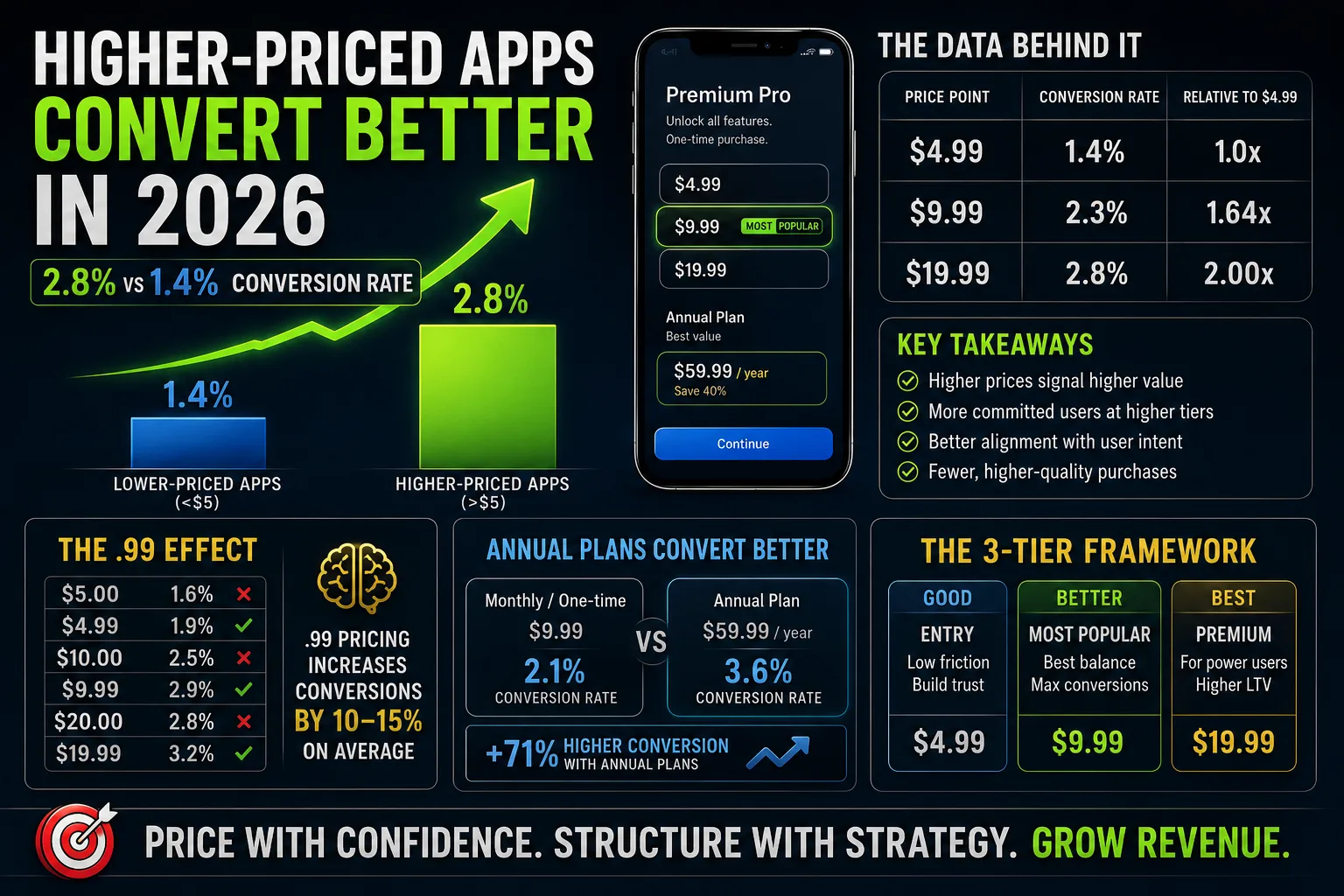
Once your trial structure is sorted, the rest of the pricing architecture matters too. Our subscription pricing guide covers the $4.99 vs $9.99 vs $19.99 math and the 3-tier framework that consistently wins. For the infrastructure side — RevenueCat vs in_app_purchase, web subscriptions, paywall A/B testing — our RevenueCat vs in_app_purchase guide covers the build-vs-buy decision. And for the commission math, the Apple Small Business Program guide covers cutting commission from 30% to 15% on your first $1M in proceeds.
Related posts
Make your App Store screenshots free
LaunchShots is a free, in-browser screenshot maker. No signup, no watermark.
Open the app →
Comments (0)