Zero-budget app marketing: what actually works for indie developers (2026)
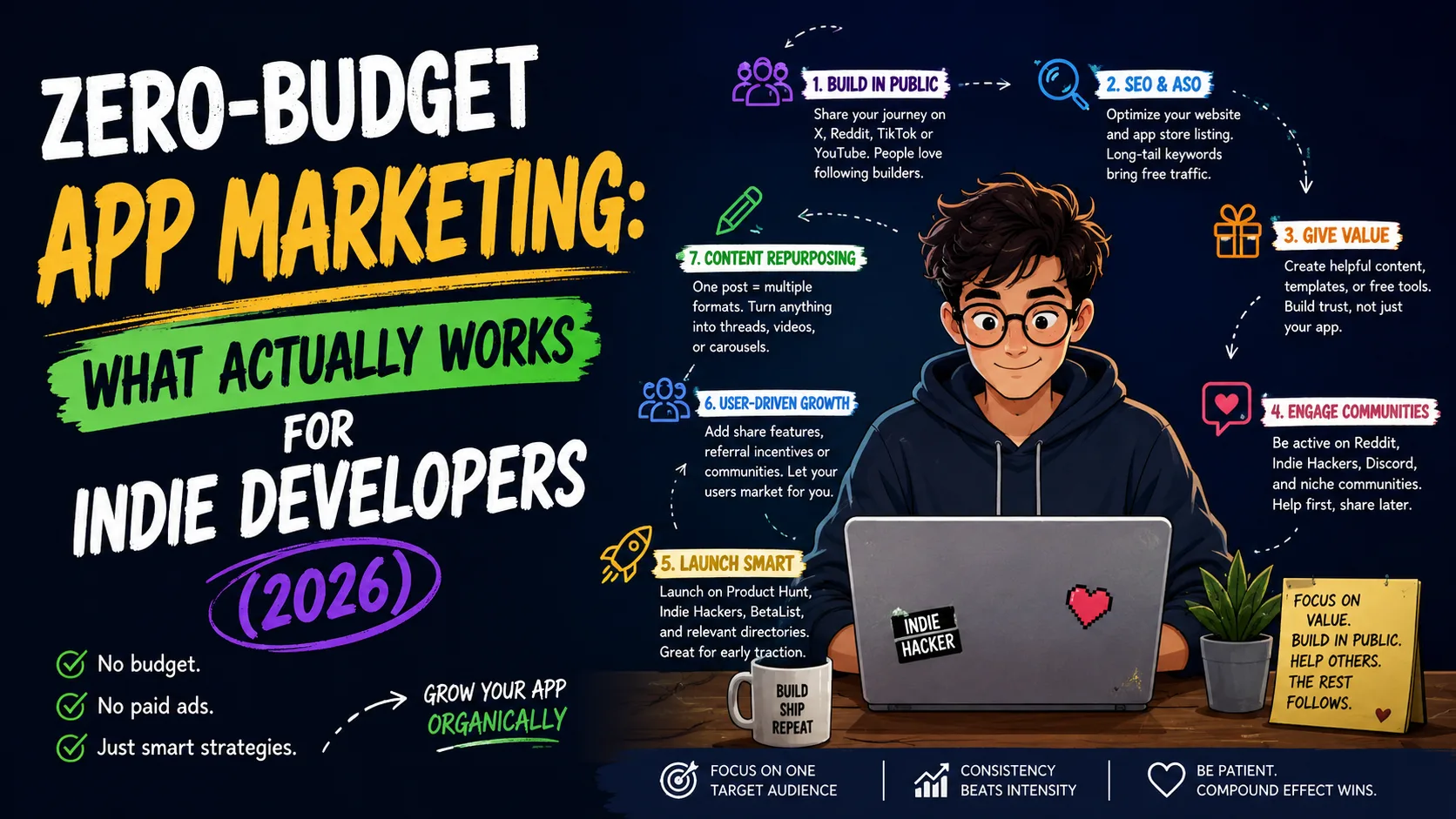
Most app marketing advice assumes you have a budget. You don't. You shipped an app, you have $0 to spend on ads, and you need real users — not vague "build in public" platitudes. This is the honest playbook of what actually works for indie developers without a marketing budget in 2026: the tactics that move the needle, the ones that waste your time, and the order to do them in. Some of it is slow. None of it requires money. All of it has produced real downloads for real indie devs — including this one.
Start with the thing most "marketing" guides skip: a product worth talking about
Zero-budget marketing only works if your app gives someone a reason to share it. That doesn't mean it has to be polished or feature-rich — it means it has to solve one specific problem clearly, for one specific kind of person, better than the obvious alternatives. If your pitch is "another to-do app, but cleaner," you don't have a marketing problem, you have a positioning problem. No amount of Reddit posts will fix it.
Before spending time on any channel below, write down: who is this for, what one thing does it do better than what they use now, and why would they tell a friend about it. If those three answers are vague, fix the product first. Marketing amplifies what's there; it doesn't create it.
Reddit is the highest-leverage channel — if you respect it
Reddit is the single best free distribution channel for indie apps, and it's where most developers either win big or get banned in their first week. The community sees through self-promotion instantly. What works:
- Pick the right subreddit. r/SideProject, r/IndieDev, r/IndieHackers, and your app's specific niche subreddit (r/productivity, r/Fitness, r/iOSProgramming, etc.). Read the rules. Some allow promotion on certain days, most don't allow it at all unless framed correctly.
- Lead with the story, not the link. "I built this because I couldn't find X" works. "Check out my new app!" gets removed in ten minutes. Be specific about the problem and what makes your approach different.
- Show, don't tell. Attach a screenshot or short demo GIF. Image posts get 2–3× the engagement of text-only.
- Reply to every comment in the first two hours. Engagement signals tell the algorithm to keep showing your post. A thread with active comments outperforms one with passive upvotes.
- Don't post the same link to multiple subreddits in a day. Reddit's spam filters flag this fast, and once your account is shadowbanned, recovery is painful.
One good Reddit post in the right sub can produce more downloads than a month of Twitter activity. The trade-off is that it's high-variance — you can write a thoughtful post and get four upvotes, or write a quick one and get a thousand.
ASO is free, permanent, and most devs do it badly
App Store Optimization is the closest thing to passive distribution that exists. Once you rank for a keyword, downloads come without you doing anything. The problem is that most indie devs treat ASO as an afterthought — they pick a name, write a description in five minutes, and wonder why nothing happens.
The basics that move the needle: a clear, keyword-rich subtitle (the App Store weights it heavily); a description that front-loads your best-performing keywords in the first three lines (that's all most users see before tapping "more"); the full 100-character keyword field on the App Store, populated with low-competition long-tail terms rather than impossible head terms like "fitness" or "productivity"; and screenshots that show value within the first frame, since people scroll past listings in under two seconds. If writing the copy is the part you're dreading, our ASO description generator handles it free.
Screenshots are your conversion lever, not your design portfolio
Once someone lands on your store listing, screenshots do most of the work. They outperform every other listing element in conversion tests, and the first two carry the weight. Plain device-frame screenshots — just your UI in an iPhone outline — leave conversion on the table. Add a clear caption that says what the user gets, lead with your strongest feature, and make sure text is legible on a small thumbnail. Our guide on screenshots that convert goes deep on the patterns that work.
Build in public, but make it interesting
"Build in public" gets dismissed as a meme for a reason — most of it is uninteresting. "Day 47, refactored the auth layer" is not content. What works is sharing decisions, mistakes, and numbers: specific revenue figures, A/B tests that surprised you, redesigns that flopped, conversations with users. The currency of indie Twitter/X and Bluesky is honest specifics, not generic milestones.
Don't try to be a personality. Try to be useful. The accounts that grow are the ones that share one concrete thing other indie devs can apply tomorrow.
SEO is slow, but it compounds
If your app solves a googleable problem, writing one well-researched blog post per week aimed at long-tail keywords will outperform almost any paid channel over twelve months. The math is unintuitive: a post that ranks for a 200-search-per-month keyword brings in 200 visitors a month, every month, indefinitely. Twenty posts at that scale is 4,000 monthly visitors with zero ongoing cost.
The catch is the time horizon. Nothing happens for the first three months. Most developers quit before the compounding kicks in. The ones who don't end up with a moat that's nearly impossible to compete with on a budget.
Tools and content as marketing
This is the most underused tactic in indie marketing: ship free tools that your target users need anyway. If you make a fitness app, build a free BMI calculator. If you make a habit tracker, publish a free habit-streak template. If you make a developer tool, ship a free version of one feature. These tools rank for high-intent search terms, attract the exact people who'd want your main app, and require zero ongoing cost to maintain.
It's how this site grew. The screenshot editor pulls in indie developers who need store assets; the icon generator, ASO writer, and feature graphic maker do the same. Each tool is its own SEO surface, and together they form a self-reinforcing network. You don't need to give away your main product — give away the thing your users would have built themselves anyway.
Product Hunt is a moment, not a strategy
Product Hunt can be useful, but it's badly misunderstood. A successful launch produces a spike of traffic, some signups, valuable backlinks, and roughly nothing afterward. The mistake is treating it as a growth channel rather than a one-day marketing event. Launch when you have something newsworthy, prepare your assets carefully, and don't expect a featured placement unless you've built a hunter network in advance. The backlinks alone are worth doing it once, but don't rebuild your roadmap around it.
What doesn't work (on zero budget)
A few things consistently waste indie devs' time:
- Cold DMs to influencers. Without a budget, conversion is near-zero and you'll burn relationships fast.
- Paid app review submissions. Most "app review" sites either don't have traffic or charge for placement that converts at terrible rates.
- Twitter follow-for-follow rings. Inflated follower counts don't convert. Genuine 500 followers beats fake 5,000.
- App store ads on $20 budgets. Apple Search Ads need real budgets to learn; small experiments burn cash without producing actionable data.
The realistic order of operations
If you're starting today with $0 and an app that's live: lock down ASO basics this week (subtitle, keywords, screenshots). Post once to the most relevant subreddit, lead with the story, reply to every comment. Start one blog post per week aimed at a specific long-tail keyword. Plan a Product Hunt launch four to six weeks out, while building your assets. Then keep going for a year. The developers who get traction without a budget are almost never the ones who tried five channels in their first month — they're the ones who picked two and stayed disciplined for twelve.
None of this is a hack. It's slow, compounding, organic work. But for indie developers without a war chest, it's the only honest path — and unlike paid acquisition, the assets you build never stop working.
Related posts
Make your App Store screenshots free
LaunchShots is a free, in-browser screenshot maker. No signup, no watermark.
Open the app →
Comments (0)